



















Convenient, fast and eco-friendly — or chaotic, unsafe, and unregulated? The e-scooter debate is racing toward uncertainty.
E-scooters — like most polarizing topics that divide or unite people based on interests, personal agendas and inherent pros and cons — are triggers for the voices of assent and dissent, with little room for alternative opinions.
This past summer of 2025, the City of Vaughan announced their two-year participation in the Shared Micromobility Pilot, under which e-bikes and e-scooters — stand-up two-wheeled devices powered by electric motors and equipped with rechargeable batteries — are included. In conjunction with approved e-scooter and e-bike providers, rental services operate within defined boundaries and are accessed through smartphone apps, with users picking up and returning the devices at designated parking locations.
In an email interview, Vaughan’s Communications, Marketing and Engagement Department says the introduction of the micromobility initiative is one that “introduces a sustainable transportation option for short trips across the city through shared electric scooters and e-bikes, available for rent via smartphone apps. This initiative is part of Vaughan’s ongoing commitment to offering a more connected, accessible and sustainable transportation network.”
However, the City of Toronto’s 2021 nonparticipation in the micromobility pilot project highlights the confusion, lack of training and education and ignorance regarding the rules of the road, including the Highway Traffic Act’s age minimum for riders and its helmet requirements.
“We see mobility devices as a public safety issue,” says Inspector Matt Moyer of the Toronto Police Service’s Traffic Services. “Toronto has a population of 4 million people. The number of cars on our roads and the issues that play into Toronto’s infrastructure may not apply in other municipalities. There has also been an increase in injuries in small children, including reported head injuries in emergency rooms around the city, including Sick Kids Hospital. Public outcry about public safety in the city and how people are using these mobility devices is concerning.”
Dianne Saxe, councillor for Toronto’s Ward 11 University-Rosedale riding, is, however, a supporter of e-scooters for adults, stating that she has worked diligently to authorize e-scooters in Toronto with appropriate safety precautions.
“I wanted the bike-share program, led by the Toronto Parking Authority, to be expanded to include e-scooters, which I propose would be equipped with speed limits, helmets and geofencing technology to keep them off the sidewalks, which I think would be safer than the current situation, which is a free-for-all,” Saxe says.
And while Saxe acknowledges there are some problems with e-scooters — their small wheels tend to get stuck in potholes and streetcar tracks — the overall benefits outweigh the risks.
“E-scooters are an inexpensive mode of transportation,” Saxe says. “They are lightweight and small, and because they are electric, there are zero emissions. In fact, I have heard from women who ride e-scooters that they feel much safer getting to and from public transportation options at night.”
The lack of dedicated lanes, confusion around where e-scooters are permitted, speed limits and correct parking parameters are issues that are causing deep rifts and safety concerns, especially for children and teenagers who have been given these devices by their parents.
“E-scooters are illegal in the City of Toronto and yet we see riders of all ages not wearing helmets and always standing on their devices. I do not see many kids wearing helmets, and some are going 30 to 40 kilometres an hour,” Moyer says. “Parents need to think seriously before letting their kids ride these devices.”
Dr. Daniel Rosenfield, emergency medicine physician at The Hospital for Sick Children (SickKids) and Chair of the Injury Prevention Committee for the Canadian Pediatrics Society, is concerned by what he is seeing in emergency rooms.
“For context, in 2023 we had 27 cases of injuries from e-scooters and in 2024 that number rose to 46 cases. As of August 2025, we have treated 74 injuries related to e-scooters in young people, which is a 60 per cent increase compared to the previous year. The injuries we see range from minor bumps, scrapes and bruises to fractures and major trauma, including traumatic brain injuries, rib fractures and solid organ injuries such as liver lacerations,” Dr. Rosenfield says.
WHERE CAN I RIDE MY MICROMOBILITY DEVICE IN VAUGHAN?
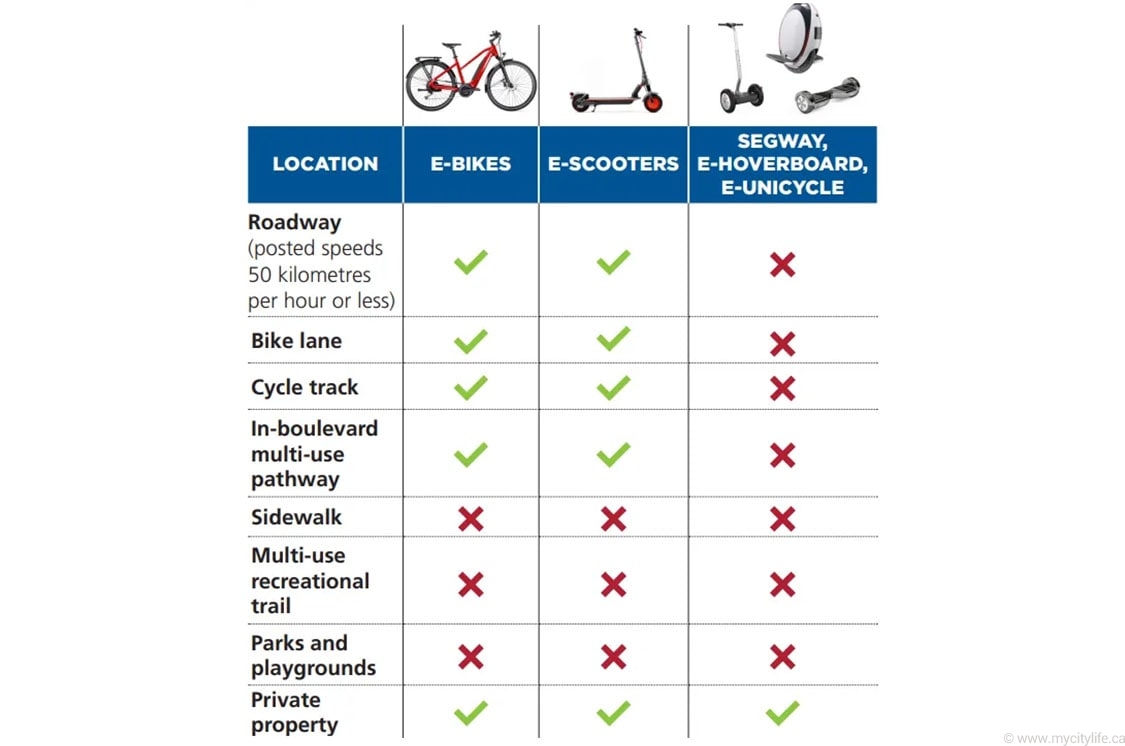
*Information Sourced from the City of Vaughan Micromobility Page
“Injury severity is influenced by factors like the speed at which an e-scooter is going and if the young rider has been hit by a car. Unfortunately, our data is unequivocal when it comes to helmet use — kids who sustained injuries on e-scooters were not wearing helmets, and that makes any head injury much worse,” he continues. “While the provincial laws state that the speed of e-scooters should be maxed out at 24 kilometres an hour, if you look on any big-box retailer’s website, you will see claims that the advertised devices can attain speeds of 40 to 50 kilometres an hour. Injuries sustained at 20 kilometres an hour are going to be less severe than those sustained at 40 kilometres an hour.”
Other issues with e-scooters centre around fires related to the lithium-ion batteries that power these micromobility devices. According to Toronto Fire Services statistics, the number of lithium-ion battery incidents increased significantly from 2020 to 2025. In 2020, three incidents involving micromobility devices (both e-bikes and e-scooters) were reported. By 2022, the number had grown to 15. The 2025 incident numbers to date are 39, a notable jump from 2024, when there were 25 occurrences. It should also be noted that lithium-ion batteries have a limited lifespan and pose challenges in terms of disposal and recycling.
“It’s a nuanced discussion regarding access to micromobility devices because the issue is so new,” says Dr. Rosenfield. “Toronto traffic is a disaster, and people need to be able to get around efficiently. There is probably a place for these devices, but certainly not where kids are concerned.”
Todd Snooks, Program and Partnerships coordinator for the York Regional Police’s (YRP) Road Safety Bureau, states that as far as the rules around micromobility devices are concerned, the situation has been implemented backward.
“My concern is that over the next 10 years we are going to see a huge increase in serious injuries and fatalities relative to micromobility devices.”
“Micromobility devices were thrown into the market with no rules in place. And now we are trying to get legislation to effect the rules,” Snooks says. “As a result, it is a mish-mash of trying to educate parents, school boards and young people. So many parents are purchasing these mobility devices for their children for birthdays and Christmas, and subsequently these young people are riding them anywhere they would usually ride their non-electric devices. If they are under the age of 16, they only know the rules of the road as pedestrians. They don’t know what the road signs necessarily mean, so they are going through stop signs and riding on the sidewalks. These devices should not be going more than 24 kilometres an hour, but there are ones — they are not legal — that go up to 70 kilometres an hour.”
There were two alarming e-scooter accidents in Toronto on September 29 — one rider was 10 years old and the other was 12, and both children sustained serious injuries — which have ramped up the discussion of the viability of young people using e-scooters.
This leads to a burning question: How can we possibly expect youngsters and teenagers who are susceptible to the peer pressure of showing off or giving their friends a ride on their device — to be cognizant and respectful of the rules of the road, that is, the Highway Traffic Act? We can’t.
As parents and community members, we would be naïve to think that young kids are mature enough to grasp the responsibility of driving a motorized vehicle, even with limited speeds. Trust is one thing — but as adults, we have to be honest with ourselves when it comes to trusting our 10-, 11- and 12-year-olds with e-scooters. Even more seriously, they have little to no comprehensive knowledge of the rules of the road.
As a proactive measure to provide education on the topic and at the request of the school board, YRP officers will be at four schools in Vaughan over the next few weeks to discuss road safety with parents and to hand out postcards that lay out the rules of micromobility usage.
“We are seeing a significant decrease in fatalities in vehicle-to-vehicle incidents, but my concern is that over the next 10 years we are going to see a huge increase in serious injuries and fatalities relative to micromobility devices because their usage is not being managed properly,” Snooks says. “Our message to parents is clear: your kids should not be riding to school on these devices.”