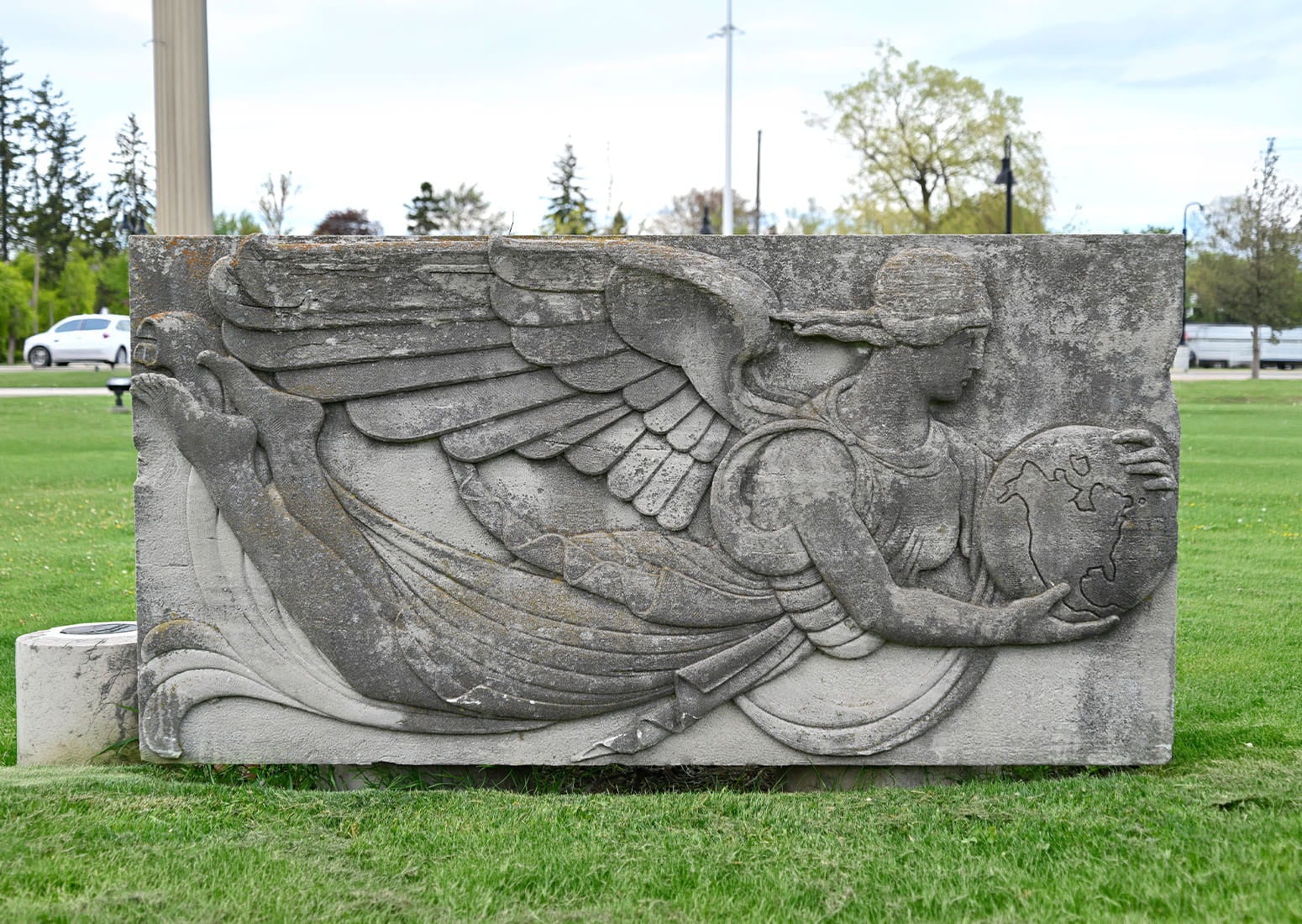
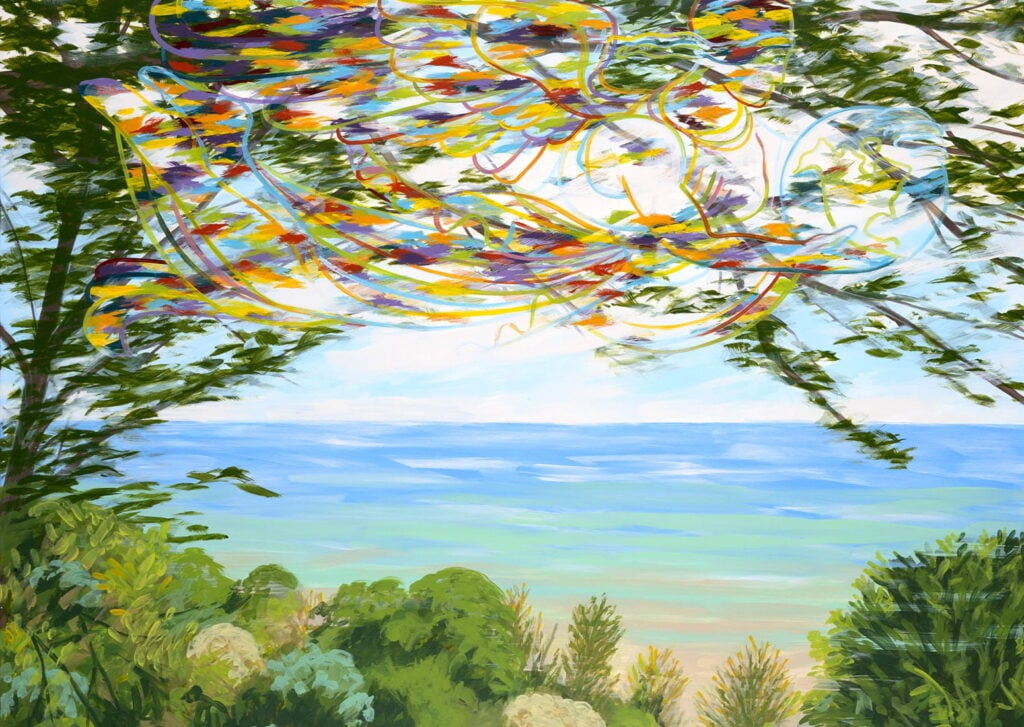
The Toronto artist is presented her interpretation of the salvaged stone carvings at the Clark Centre, which has its own special connection to the ornaments.
Toronto artist Katharine Harvey has often used light as a subject throughout her painting career — whether it’s when painting ceilings and domes of various architectural spaces or depicting architectural windows.
Harvey’s latest project, an exhibition titled Turning in the Light, at the Clark Centre for the Arts from October 3 to 29, explored the question “What if the ornate details of Toronto’s demolished historic buildings could tell us something about the city we are becoming?”
In the 1960s and ’70s, a kind of urban-renewal mania seized Toronto during which historic buildings were demolished to create space for skyscrapers. Spencer and Rosa Clark brought architectural fragments to the Guild Inn Estate. Now, even though the historic buildings themselves no longer exist, some architectural fragments — including elaborately carved stone floral motifs and architectural details, can be found nestled among the park’s trees and gardens on the Scarborough Bluffs overlooking Lake Ontario.
Harvey’s research of Guild Park began this past April. “I had never been to Guild Park or Clark Centre,” she says. “So it was a whole new part of the city and a whole new way of looking at the world, seeing these remnants in Guild Park that had been rescued from downtown Toronto buildings. Studying those was surprising and fun, and that led me to a whole body of work about the park.”
Harvey walked around the park and waited to see which sculptures and remnants spoke to her.
The outcome is a collection that invites viewers to reconsider what the world defines as progress. What do we lose when historic buildings disappear, for example? The beauty of art is that it has the unique ability to preserve and reinterpret — reimagine, even — a city’s architectural identity.
Harvey employed the same title — Turning in the Light — because she felt that “turning” speaks about the passing of time and it speaks about things in motion. “I like to paint objects in motion,” she says. “At Guild Park, the carved stone remnants show themselves in the light. And as the sun moves across the park, the shadow deepens. The stone isn’t turning in the light — the light is turning around the stone.”
At the core of Harvey’s work is a fascination with the unseen and what that place holds beyond what we notice at first glance. “I delve deeply into the imagery and look at the meaning of how that relates to culture today,” she says.